Pneumatic cylinders are among the most adaptable motion-control components used in today’s automated systems. They transform compressed air into reliable mechanical force, allowing industries to move, lift, position, rotate, and control machinery with remarkable efficiency. As automation becomes more intelligent and compact, industries increasingly depend on experienced pneumatic cylinder suppliers and every trusted pneumatic cylinder manufacturer to deliver specialized cylinder designs that match modern engineering challenges. Understanding the major types of pneumatic cylinders helps engineers choose the right option for performance, durability, and motion precision.
Understanding Single-Acting and Double-Acting Cylinders
The first two types single-acting and double-acting cylinders represent the foundation of pneumatic motion. A single-acting cylinder relies on air pressure to move the piston in one direction, while an internal spring or external load returns it to its start position. This design simplifies operation in systems where movement occurs in only one direction, such as compact machines and repetitive ejection tasks. Their mechanical simplicity also reduces air usage, which is why they remain valuable in energy-conscious environments.
Double-acting cylinders operate differently, using compressed air for both extension and retraction. This gives them full bidirectional control, allowing them to handle heavy loads, precise movements, and fast cycling. Industries that depend on constant motion—robotics, packaging equipment, automotive assembly, and large manufacturing machinery—rely on double-acting cylinders for their balanced force output and dependable speed control. Any pneumatic cylinder supplier will confirm that double-acting cylinders remain the preferred choice for high-demand production lines.
Compact Cylinders: Power in Limited Spaces
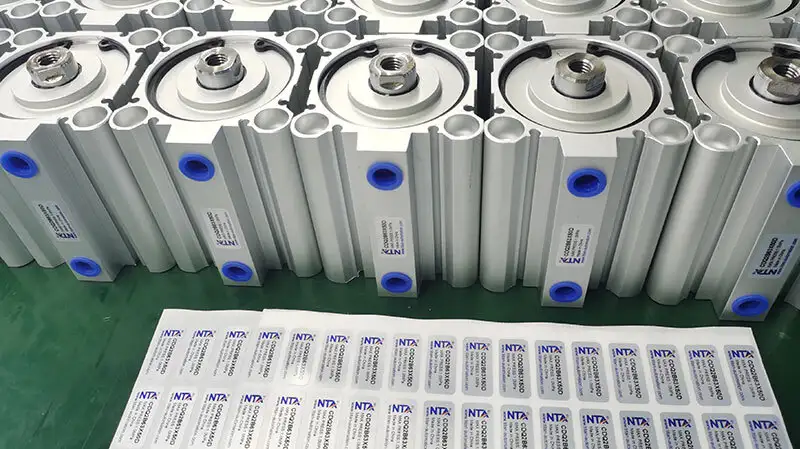
As industrial spaces become more crowded with advanced machinery, compact pneumatic cylinders have gained importance. Their design focuses on achieving maximum power within the smallest possible footprint. Unlike standard cylinders, compact versions offer short strokes but deliver surprising pushing force relative to their size. They are frequently used in modern automation modules, miniature assembly lines, and precise positioning systems where space is extremely limited. Their ability to fit into tight areas without sacrificing functional performance has made them an essential component for OEM projects that require efficiency and stability in restricted environments.
Compact cylinders also reflect the innovation happening within the manufacturing sector. A quality pneumatic cylinder manufacturer understands that many new automation systems require flexibility in mounting, lightweight construction, and low-maintenance designs. Compact cylinders meet these expectations by offering strong operational stability while minimizing the design complexity of the machines they integrate into.
Rodless Cylinders and Rotary Cylinders: Expanding Motion Capabilities
Modern industrial layouts often face the challenge of achieving long-distance linear movement without creating excessive equipment length. Rodless cylinders offer a solution by delivering linear motion along the cylinder body through a sliding carriage instead of an extending rod. This eliminates the need for additional clearance space, allowing long strokes within compact machine designs. Rodless cylinders are widely used for transferring components, positioning materials along conveyors, and moving platforms in automated workstations. Their space-saving design has made them indispensable in factories striving for higher efficiency within smaller footprints.
Rotary cylinders introduce an entirely different dynamic by converting compressed air into rotational motion rather than linear travel. Their internal mechanisms often vane-based or rack-and-pinion designs allow them to generate precise angular displacement. They are commonly chosen for indexing tables, valve actuation, robotic wrist movement, and machinery that requires repetitive rotation with controlled torque. A knowledgeable pneumatic cylinder supplier understands that rotational motion is just as essential as linear movement in advanced automation systems, and rotary cylinders bridge this functional gap with dependable performance.
Conclusion
The five types of pneumatic cylinders each offer distinct advantages that serve different engineering needs. Whether the goal is reliable one-direction motion, powerful two-way control, compact force generation, long-stroke operation, or controlled rotation, modern automation depends on these cylinder designs to keep machines moving efficiently. Choosing the right cylinder begins with partnering with an experienced pneumatic cylinder manufacturer that understands customization, application demands, and long-term durability. As industries evolve, these cylinders remain vital components that enable high-precision automation and continuous productivity.
